Young Elephants Duel With Each Other

Young Elephants Duel With Each Other
Liwonde National Park

Friday, December 16, 2011

Walking the Zomba Road

          Walking along the right side of Zomba Road just east of the Thondwe Trading Center, and the Namikango Maternity Hospital and Mission, it is difficult to understand how anyone can move from place to place along this road if they are physically handicapped, and have difficulty walking.                                                                                                   

Malawi is a "nation walking" and the average person walks ten miles a day. This means heavily traveled roads like this one are very dangerous to both drivers and pedestrians. On this walk along the road I hold my camera in front of me, and walk directly in the pathway so many people are walking every day

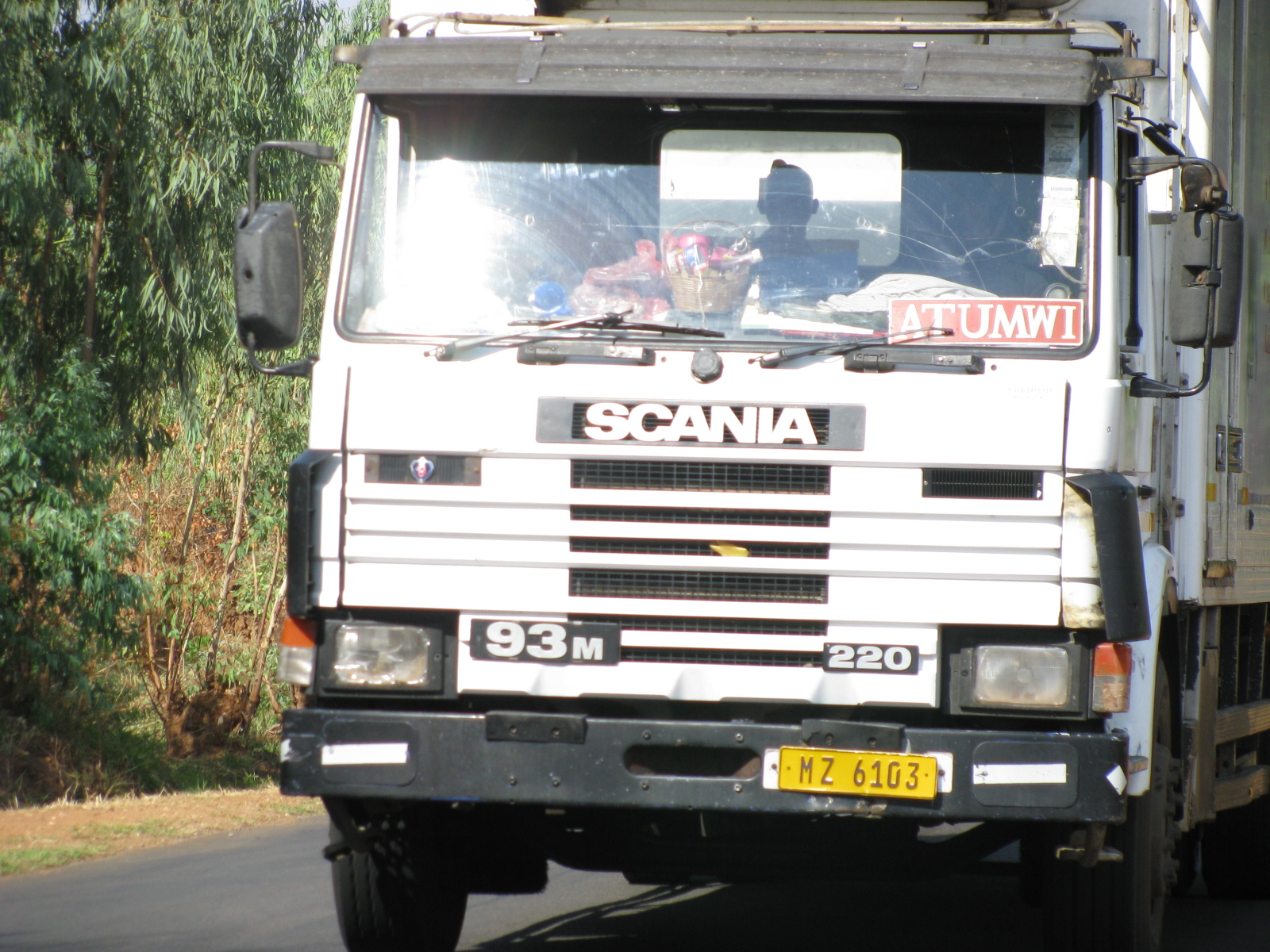
As I watch the oncoming traffic a large truck begins to pass on the curve a short distance in front of me. The truck tire rides the edge of the pavement, as the truck hurdles toward me. As he passes me the side of the truck is just inches from me as he passes.

Another truck approaches and I can see the concerned expression on the face of the driver, in spite of the broken window in the cab and the glare of the sun on the windshield.


I was able to breath a large sigh of relief when we reached the maternity hospital and mission grounds after just a short walk to the east along the roadway. It is no wonder so many people are killed on the roadways of Malawi.

That is Close Enough

 "At a time like this one has to be glad to be safely in a boat, with a wise and prudent guide. If we were on land we would be in a bit of trouble getting this close to the elephant herd. But when on water, with them on the land, they are not as fearful of us ... and neither are we of them (I think). It is morning in Liwonde National Park in Southeastern Malawi, and we are on boat safari on the Shire River. This is the same river David Livingstone traveled on his quest to explore the interior of Africa over a hundred years ago."

Thursday, August 4, 2011

Seeking the Little People (2)


In our last report we were making our way carefully up a rather steep mountain road in search of evidence of the little people, or the pygmy race that once inhabited this part of Africa. Were they real, or were they the imagination of overactive minds? What will we find at the end of the trail? Will we get simply a great view, or are we going to see something that will prove their existence?
We have traveled south of the capital city of Lilongwe, and turn at the south edge of the Dedza Trading Center. At a local landmark, Dedza Pottery, we ask for directions. They advise us, “Go east along this road, something like 11 kilometers, and you will find the school. Ask the kids to take you there. They all know the place.”
  Along a pothole filled, washboard road, we are able to locate the school after traveling approximately 20 kilometers. We park in the schoolyard, and look for one of the teachers. He is most kind and actually stops his class to discuss our needs with us. He suggests he can help locate students who know where to find the cave drawings. If we can find actual drawings, we will have the evidence to convince ourselves of the presence of the little people several hundred years ago. I cannot help wondering why, if we are about to discover such an important site, it has no tourist signs, travel markings, or anything else to indicate it’s exact location. How can they be so important, at the same time in such a remote, non-descript location, and not even show on a local map? I have to wonder what we are really going to see. Will we see evidence they have been here, or will we simply capture a scenic view of the mountains, and valleys that extend off in the distance?


View is Breathtaking
Part way up the mountainside we stop to rest, catch our breath, and look out over the panorama that sprawls below us to the southwest. It really is breathtaking, with the beauty of the valley punctuated by the rock outcroppings of mountainous granite protrusions extending high into the blue sky. Lens caps off, cameras focus, and click, click, the shutters open and close to capture views that can never be fully taken into custody.
                   

A little farther up the path we see, coming toward us down the mountain, three young girls carrying bundles of sticks on their heads. These will be used or sold for cooking fires. They pass quietly to our left. As they detect our cameras they turn slightly so their profiles can be captured by the camera’s view. The trace of broad grins reflect from their faces. 


The mountain steepness increases, and it quickly becomes more difficult to navigate. The dirt road has been reformed into a small path, and even that sadly disappears behind us. Only a few indentations in the grass in front of us seems to indicate we are following some sort of course that others have followed before us. The boys seem sure of themselves, however and their confidence reassures us that history waits just around a curve near the top of the mountain.


Drawings are Evident
We move cautiously around a cliff face, and to our right a cave looms out to meet us. The formation the ceiling appears to be about 50 feet above us, and in seconds we see them plainly high above us. White images. Clearly markings made by man. Images sketched of human beings and animals. The distinct image of a crocodile seems evident. Off to the right, but still high on the ceiling, a smaller image appears to be a monkey of some type. 


Our group grows quiet, and the Malawian guides stand quietly to the side as the realization comes to all of us that people hundreds of years ago were in this very cave recording some aspect of their lives, their knowledge and their history. Silence lasts for several minutes as each of us experience some type of reverence for the past of this place. Near the bottom of the rock, well below the drawings, graffiti from recent intrusions desecrate the importance of this place. It is both amazing and sad that such an important and intricate piece of the history of a people, who have been lost in the annals of history, can be so insulted. The students now realize how important we consider this find so their excitement increases as they lead us to a second cave where images of what appears to be adult and child drawings are equally evident. Again silence surrounds us as we realize we are looking directly into the past at some the last evidence of a people who disappeared from the world scene without the world recording its departure, or a reason it occurred so suddenly. 


Who were the people who lived in this cave? What was the significance of what appears to be a crocodile wall painting when rivers and lakes that contain them seem to be, at least today, hundreds of miles away? Was this a crock, as we know them today, or was it some sort of giant land creature? Why was a monkey looking creature drawn near by? Were these animals the source of food, or were they in some way revered or worshiped? This hidden mountain top contains no brochure rack of literature to give the visitor an explanation for the drawings, nor do the students or teacher have clarification for our questions. The mystery will remain locked away. The explanation will come another day from some other source.


Views Are More Spectacular
Coming down the mountain the view to the south and southwest is even more spectacular since we face outward toward the view instead of toward the mountain, 
as we were when we were climbing toward the top. The schoolboys are visible excited to be escorts to the Americans and their excitement seems to grow as the group descends toward the school. Perhaps their classmates will now appeal to their great wisdom and knowledge of what the Azungu (white faces) are like. After all, most of the children in the school will have had no first hand knowledge or experience of ever having been with Europeans or Americans.


Reaching the school we offer a few Kwacha to each of the children for their assistance, and take into account the teacher’s request for schoolbooks, pencils and paper for his students. Perhaps one day we can return to the school with a vehicle full of supplies, a reward for their assistance to allow us to see and record a piece of the past.

With some sadness we climb back into the vehicle, and retrace our route back to the Dedza Trading Center. At that juncture we turn south to begin a route we have been told is a new road crossing the mountains and down into the valley toward the big lake. We cannot confirm this fact, even with those we have met in Dedza, but we will soon find out if it is true, or we may find ourselves on impassable roads, in improbable places as we “Travel Malawi.”

Saturday, June 18, 2011

Seeking the Little People (1)

         The reports brags that this area, “Situated within a cluster of forested granite hills and covering an area of 126.4 km2, high up the plateau of central Malawi, features the richest concentration of rock art in Central Africa on 127 sites.” It is reported to be the famous Chongoni Rock-Art Area, and we are headed there from the capital city of Lilongwe. Our first stop, to get directions, in the Dedza Trading Center, and our information will come from one of the workers at Dedza Pottery. She is most helpful and after taking a couple of mental notes we are on our way toward the mountains.


We pull onto the road from the Dedza Pottery Shop and turn left toward the higher mountain peak to the east. The center of the road appears hardened from the heavy traffic of old dilapidated logging trucks, while the edges are potted with unexpected and abrupt ruts and drop offs. It is not unlike most of the unfinished roads that traverse the countryside away from the few tarmac highways. Torrential rains that plummet the landscape from October to April end the usefulness of many Malawi roads, and the government has few resources to restore them to full usefulness when the dry season spreads itself across the landscape.

Two black oxen, heads lowered, pull a weather beaten cart west along the road. The young driver in an old worn brown shirt encourages them to the side of the road with a long stick. Out the side windows of the Isuzu we see a number of dust covered white bags piled in the back. It is probably a family’s precious supply of maize headed for the mill to be ground into fine powder for nsima, the staple diet of every Malawi family.

In front of us we begin the accent toward the higher peaks around Dedza Mountain, and the valley floor quickly falls off to the right. “Eleven kilometers,” the clerk at the pottery office had advised us. Obviously she would know of the caves since she lives in the area, and her instructions were reassuring, even when she noted they are “just near.”

They Can Help at the School
“Stop at the secondary school when you come to the large stone sign beside the road,” she said. “Since there are no signs to show where the caves are located you must get directions from someone at the school. They will be glad to help you.”

       Ahead of us tall forests of dark green pines begin to appear. Their majestic height stands proudly as a testament to the efforts of the government of Malawi to restore some of the forest land that has been stripped away by a growing village population that are using wood far faster than they can grow trees for the future. The blue of the sky and the puffy white clouds coming in from the east emphasizes the green of the forest. A small boy with a 6-foot long bundle of brush on his head quickly veers off the road, down through the deep ditch, and into the clear area near a small mud hut. Our vehicle throws a shroud of dust in his direction, but he is to sharp-witted to be overtaken by its suffocating dust. Reaching the 11-kilometer mark we see no evidence of a school. Twelve, thirteen, fourteen. Maybe it is time to consider turning back to review our directions? Fifteen, sixteen. We must have missed our marker for the school. Maybe we should turn back. Let’s go up to the next curve on the mountain then we will turn back and get new directions.


Then suddenly at the seventeen-mile marker we come to a small fork in the road, and a stone marker standing directly in the middle of the road. There is nothing printed on the marker except a coat of old black paint that may have once been an indicator of some message that once adorned its surface. Off to the right a small cluster of old buildings signal the possibility of a school. We steer the Isuzu up on the grass between the leading buildings, and seek assistance. A small group of girls who understand some English indicate we are at the secondary school. They respond positively to our request to locate one of the school officials.


They rush off toward the back of the property with us trying to keep pace. At one of the last houses a teacher steps out from where he has been processing a test. We explain our dilemma, and ask if the school might have a student, or someone, who could point us to the caves where the markings may be observed. He says he will take us. We start to object, as we do not want him to interrupt his day of teaching in order to assist us, but our attempt to persuade him not to go falls on ears that do not hear our objections. He leads us out toward the road we have just come up.


Three boys quickly join him so they can help escort us up the mountain. By the time we cross the road it is evident the boys know the path better than the teacher. It is a boy in a red sweater that takes the lead for the first part of the trip. On the north side of the road we begin moving through the underbrush along a small dirt path. The path gets even smaller as we ascend the hillside toward the crest, and we begin to get an uneasy feeling, wondering if we have the right people taking us the right direction. How can this be such a major site for the history of this part of Africa, with cave drawing from hundreds of years ago, yet have no markings along the way, and no evidence the caves contain such a slice of the past?


Next: Will we really find cave drawings, or just a scenic view?

Monday, May 23, 2011

Relax at Lujeri Tea Estate


Our trip is a two-day get away in southern Malawi. We have learned about a quaint, quiet, and scenic place that is just the setting where we can recover our strength after a case of malaria. Our destination is nestled on the beautiful slopes of Mulanje Massif, a 9,842-foot (3002 meter) peak, and 13 x 16 mile (22 x 26 kilometers) circumstance. From nearly level plains this majestic Isenberg leaps up out of the earth. Just the description made us want to visit. It’s isolation and beauty is going to give us time to rest, recover and plan for the next few weeks. It is not what many people do who come to the magnificent Massif. Hiking and camping probably take precedence over resting, relaxing and sleeping. But to each his own, right? Our destination is the Lujeri Tea Estate, and we have heard the elegance will remind us of a past era that we can only read.


        Lujeri is approximately 120 kilometers, or 74 miles, south of Blantyre, the commercial hub of the nation. From Blantyre the road is tarmac and easy. M-4 is relatively new, and we follow it to its end at the junction of M-2. The Marif looks at us from high above. As the clouds complete their trip across the top of the Marif, they come to the edge, then roll and tumble down the side as though they are riding a long, sloping slide to the bottom. The mountain fills the windshield of our approaching vehicle, all the way across, and from top to bottom. The view of the mountain seems to flow over the landscape in a cascade of green that is as breathtaking as we could have imagined.
           It is late morning as we pass the small trading center of Mulanje. There are the three of us, Suzi, Elias Mwale and myself. This is Elias’ first trip ever to Lujeri, even though he has heard of it all of his life. He is from the central region of Malawi, and most Malawians seldom have the opportunity to see the beauty of their land. This is a sad commentary that lives with the poor. Walking is their only means of transportation. It is also the first trip for my wife and myself.                                                                       
After passing the Mulanje Trading Center we come to the sign pointing the way. The excitement begins to build. At every curve we can see the mountain, and it continues to loom higher and higher in our view. On both sides of us are the tea fields, and the homes of the workers. Suddenly we comer around a curve and arrive at the sign pointing to Lujeri. We are staying in the main house, and it is a striking site as it lounges casually on the side of the mountain. As the dominate manor of the plantation it has a commanding position overlooking the tea estate, as well as a clear view of three other houses positioned on distant ridges, where the previous managers once lived.


There is just the three of us, but we have two housemen, and a maid hosting us. They will be taking care of our every whim. It is such a surprise for Elias, since his entire life has been filled with serving, but never being served. For the next two days he will learn what it is like to have someone serve him. Suzi and I are both recovering from a bout of malaria, so the time to relax will be great for us as well. The bedrooms, living room, and wrap around veranda are fit for a king, or queen.

Because of the distance we have traveled, we decide to just stay close to the house for the afternoon. We’ll rest, and just absorb the splendor around us. It is hard to imagine this scene sits in a land of such poverty, and pain. Just over the mountain there are mud-hut villages as far as one can see. But here, on the former plantation, there is little evidence of the deficiencies that exist in every village and trading center for hundreds of miles in every direction.


       After lunch it is time to read a paper, explore the rest of the house, and then go outside for a dip in the pool. 


            We spend the rest of the day just getting in touch with this wonderland, relaxing, and watching the sun paint it’s ever lengthening shadows along, and down the east side of the mountain. Every few minutes the growing shadows and dwindling sunlight combine their resources to paint an entirely different scene. All too soon the afternoon passes, dinner is served, then a relaxing, roaring fire in the fireplace, and finally a good nights rest.


After breakfast the following morning Elias and I decide it is time to explore the estate. We take the camera and follow the winding road down, and down, until we are immersed in the green leaves of the rows and rows of tea. We spend time just admiring the scene in front of us, while at the same time talking with some of the workers coming up the side of the mountain with baskets of ripened leaves. Suzi remains behind and tries out the veranda … napping!


The road winds ever lower into the valley beside the mountain, and soon the house disappears somewhere behind us. The sound of water in the distance grows in our senses and Elias and I make our way to the nearby river. It is happily splashing and tumbling along the valley floor. The scene is breathtaking and quickly immerses the visitor in the splendor of the mountain, accented by the blue sky, white clouds, and the vivid green of the tea plants. It overwhelms the senses. Even as I snap pictures I know there is no way this scene will ever be taken into custody. It is just too immense, too complex, too complete, and too beautiful. No camera can ever catch its full enormity.


Near dusk Elias and I make our way back to the main house where the staff has the evening meal prepared.                                                                                                                                             
As the sun disappears behind the mountain, a member of the staff brings in a bundle of logs, and a roaring fire springs to life in the fireplace. A wonderful meal awaits us in the dining room nearby, and we settle in for the meal and the small talk that accompanies it. After a fine dinner, we sit in front of the fireplace until the flames begin to look for a place to sleep. It is the signal for us to settle into our rooms for the night. It has been a good day, and we still have part of another day to enjoy before we head back to our work responsibilities. It is certainly what the doctor would have ordered had he known about this place. Already, the pressure and stress of our work has been lifted from our shoulders and we are in touch with the sounds of the night as we lay there listening to the quiet hum of the tiny insects that hover near our screened window. The non-threatening rhythmic sounds lull us to sleep within minutes.

Additional pictures from Lujeri may be found at:
http://www.flickr.com/photos/malawiproject

For more information about the Malawi Project:
www.malawiproject.org

Monday, April 25, 2011

Pencils and Paper for Students


Lilongwe District, Malawi … We are near the Dowa Valley on the north side of Lilongwe, the capital city of Malawi. As we turn off the dirt and gravel road, we enter the grounds of a relatively smart looking primary/secondary school complex. This is part of the government system of schools, and the administration comes out to greet us, as we pull into the make shift parking area. With so little vehicular traffic we have available to us as many parking spots as we wish it use.

We are given a great reception. It is obvious the staff is excited to see us, and they are ready to show us the entire complex. We enter the administrative offices and meet the staff. It is amazing to realize there are no computers; little in the way of desks and file cabinets, and very little paper, pens and pencils appear on any of the desks. This is not unusual when you enter a rural school in Malawi. You often even find the students sitting on the floor. This is because so many schools do not have desks, libraries, or other supplies needed for a school. On top of this many of the students do not have pencils or paper with which to take notes of what the teacher is trying to convey to them. However, to see the administration without even the bare necessities to do their jobs is appalling.
Each year the Malawi Project sends thousands of pencils, pens and paper to the schools of Malawi on the medical shipment trailers. Contributions of pens, paper and pencils can be sent to:

Malawi Project
3314 Van Tassel Drive
Indianapolis, Indiana 46240-3555

Thursday, April 14, 2011

Travel for a Reason


           A Remote Village… It is one thing to go to Africa for a vacation. It is a very, very different thing when you go in order to help other people. Oh, don’t get me wrong. Even when you go to help others you will see the spectacular countryside, experience life in a remote village, be immersed in the sights and sounds of a major city, and taste the local food. But when you go to help other people there is an element of the trip that sticks with you, and with them, in a much different way. Nothing ever matches going into someone’s home, and finding you are quickly and deeply intertwined in his or her life. That’s the way it was that warm day when Wilson led us west and south of the Namikango Mission in order to meet one of the people who had received one of the wheelchairs we had sent to Malawi a few weeks earlier.


Not Very Far
          “It’s not far,” he says, after we have picked up a representative of the tribal chief in the area. It is repeated again, probably to try to reassure us, just as we turn off the tarmac road and start south on a twisting, tiny dirt path. We bounce along, often having to navigate over on the edge of the partially cultivated fields so we can avoid the sinkholes that cluster together in the ever-narrowing road. More twists and turns, and finally we actually come to the end of the path. The way forward looks like a menacing pile of rocks that have been laced with threads of dirt. We have reached the end of the road. “What happened to, ‘It’s not far,’ I wondered? We can’t drive any farther. From here we’ll have to walk. With the car safely locked, and an aged woman who lives nearby posted as a “guard”, we start out on foot. I take one glance back at her and wonder if she is really a guard, or just an interested spectator wondering what the white faces are doing going down over the mountain. 


           In front of us the vastness of the regal mountains and the breathtaking, sweep of the valleys stretch out in front of us in a magnificent presentation of the creative workmanship of our Creator. Cresting a rise we find ourselves looking down in a valley where people walking at just tiny dots in the distance. Leading to them are the paths, looking like tiny tan threads twisting their way down the mountain.


          “There is where we are going,” our guide indicates. He is pointing to a spot beyond the valley floor where the mountain starts its gradual rise toward a summit bathing itself in the sunlit clouds. Almost in slow motion they glide in from the east, and disappear to the west.


          The women travel with us part of the way, but eventually we reach the place where the slope drops off into the valley. Leaving the women behind on the crest of the mountain we men start down the ever-sloping edge of a massive granite dome. Beyond the rock we reach a footpath that winds its way in crisscross fashion in order not to fall off of the mountain. Near the bottom we do a little dance across a water-filled creek, hopping carefully from rock to rock. Then, having safely reached the other side without stopping to catch our breath we begin the gradual ascent toward the huts that grow ever larger in front of us as we move slowly up the mountain.


          Finally we reach a tiny village of 6 or 8 huts and are introduced to Maggie. She is quite shy, and at the age of 48 has never been outside these few huts that form an oblong ring around a tiny clearing. She is sitting on the ground where she has been pounding grain, the only staple for her family, nsima. She does not want pictures taken until a family member gets the new wheelchair she received two weeks ago from the Namikango Mission. She is very excited with it, and reports how the church has been meeting only about 200 meters away from her home for years, but she has never been able to attend. She could only sit and watch them walk past her hut. But now because of the wheelchair she can attend. She is pleased that she can get around, and both her and her husband are quick to express their deep appreciation to those people who made this possible.

          We visit for a little while longer, then make our way back down the slope, across the creek and up and over the big dome of granite at the top. Wilson Tembo, from the Namikango Mission, tells us this woman and another person in a nearby village were carried in wheelbarrows all the way from their houses to the top of the mountain so they could be at the receiving ceremony for the wheelchairs.


      Back in the car that had been safely guarded by the old woman while we were away, we carefully turn around by the big rock, and begin the trip back to the mission for the night. I could not help being glad I was here for the purpose of bringing aid to the people, and not simply and solely on a vacation to another exotic location. There is so much that is lost when travel is focused only on going someplace to gain another view, see another place, and experience another culture from inside a tour bus.